Hybrid Trolling as a Method of Information Warfare and Techniques for Combating it

Abstract
The article presents a brief report on the study conducted by the leaders of the youth volunteer organizations "Anti-Extremism" and "Community Against Nationalism" on the classification of Internet trolls, recognition of their behavior in the network content and the analysis of methods to combat Internet provocation. The authors analyze the terms "hybrid war", "information war", "psychological warfare", revealing their interconnection as parts of the whole. The study of the activity of Internet trolls of a hybrid nature was conducted on the basis of the analysis of the comments of users of social networks to the distribution of political content. The urgency of the issue under consideration is primarily in the fact that the rapid development of scientific and technical progress in the world has predetermined not only positive, but also negative manifestations, in particular, qualitative and quantitative changes in transnational and Russian crime in the field of computer information and the use of high information technologies in the commission of crimes and offenses. A distinctive feature of this trend in crime is a pronounced transnational nature, the lack of a unified approach to counteracting criminality in the sphere of high information technologies in the states of the Eurasian and American continents.
Downloads
Metrics
References
Hallin D.C. and Mancini P. Comparing Media Systems: Three Models of Media and Politics. Cambridge and N.Y., 2004.
Van Reenen, C. From Trolling for Newbs to Trolling for Cheezburger: An Historical Analysis of the Communicative Strategies of Trolling. Bowling Green, Ohio, 2013.
Nightingale V., Ross К. Critical Readings: Media and the Audiences. England, 2003.
Aro J. Yle Kioski Investigated: This is How ProRussian trolls Manipulate Finns Online — Check the List of Forums Favored by Propagandists. Yle Kioski, 24 June 2015. URL: http://kioski.yle.fi/omat/troll-piece-2-english.
Nissen T.E. Social Media, Strategic Narratives and Stratcom. The Three Swords Magazine, 2015.
Volchek D., Sindelar D. One Professional Russian Troll Tells All. Radio Free Europe — Radio Liberty, 25 March 2015, URL : http://www.rferl.org/content/how-to-guide-russiantrolling-trolls/26919999.html.
Walker S. Salutin’ Putin: Inside a Russian Troll House, The Guardian, 2 April 2015. URL: http://www.theguardian.com/world/2015/apr/02/putin-kremlin-inside-russian-trollhouse.
Wells W.D. Lifestyle and Psychographics: Definitions, Uses, and Problems // William D. Wells, ed. Lifestyle and Psychographics. Decatur, 2011.
Krovitz L.G. Putin Trolls the U.S. Internet // The Wall Street Journal, 7 June 2015. URL: http://www.wsj.com/articles/putin-trolls-the-u-s-internet-1433715770.
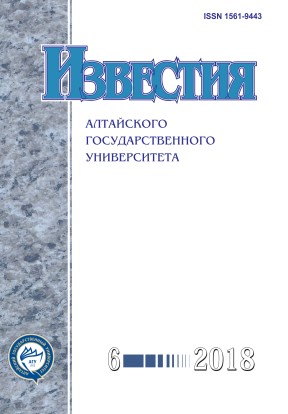
Izvestiya of Altai State University is a golden publisher, as we allow self-archiving, but most importantly we are fully transparent about your rights.
Authors may present and discuss their findings ahead of publication: at biological or scientific conferences, on preprint servers, in public databases, and in blogs, wikis, tweets, and other informal communication channels.
Izvestiya of Altai State University allows authors to deposit manuscripts (currently under review or those for intended submission to Izvestiya of Altai State University) in non-commercial, pre-print servers such as ArXiv.
Authors who publish with this journal agree to the following terms:
- Authors retain copyright and grant the journal right of first publication with the work simultaneously licensed under a Creative Commons Attribution License (CC BY 4.0) that allows others to share the work with an acknowledgement of the work's authorship and initial publication in this journal.
- Authors are able to enter into separate, additional contractual arrangements for the non-exclusive distribution of the journal's published version of the work (e.g., post it to an institutional repository or publish it in a book), with an acknowledgement of its initial publication in this journal.
- Authors are permitted and encouraged to post their work online (e.g., in institutional repositories or on their website) prior to and during the submission process, as it can lead to productive exchanges, as well as earlier and greater citation of published work (See The Effect of Open Access).